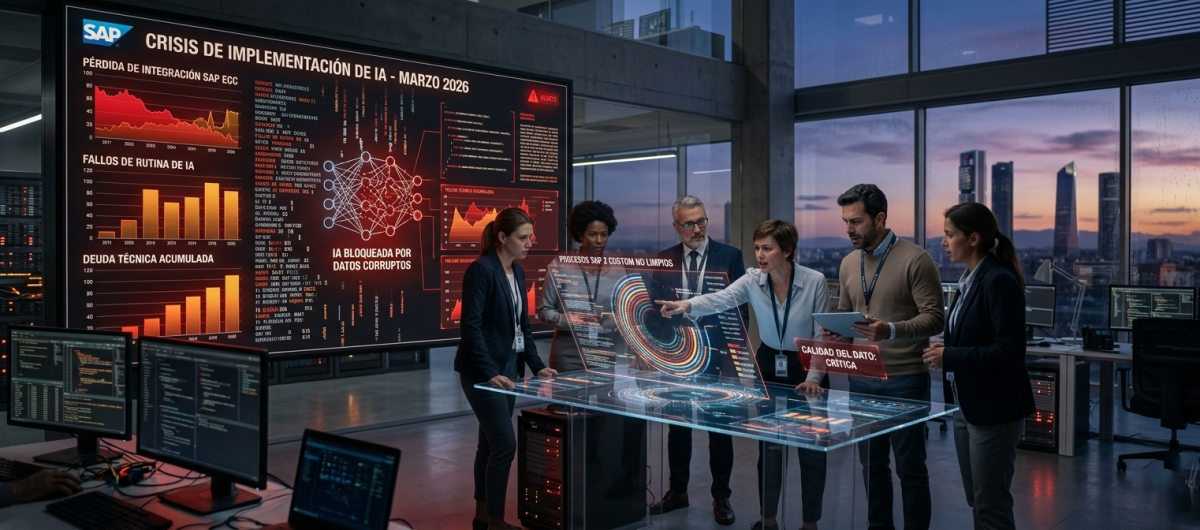
The race for rapid digitalization in Spain is starting to take its toll. According to the latest industry reports released on March 10, 2026, 40% of mid-sized Spanish companies that implemented AI solutions over the past year are now facing critical integration failures. What was initially hailed as a competitive leap has turned into an “implementation debt” crisis—a situation where AI is unable to function properly due to poor data structures and legacy ERP systems that are either outdated or heavily over-customized.
The Data Wall
The issue within the Spanish business landscape isn’t a lack of access to technology, but rather the quality of the underlying information. Many companies have attempted to deploy autonomous agents and predictive models on SAP systems that haven’t yet completed their transition to a “Clean Core.” Instead of creating fluid processes, the AI is simply replicating and automating existing inefficiencies, leading to what experts are calling “operational hallucinations.”
In Spain, where mid-sized businesses drive the economy, this technical debt has mutated into a data quality crisis. Without a clean, standardized data architecture, AI cannot draw valid conclusions for decision-making. This is stalling competitiveness compared to other European markets that have more mature data-cleansing processes in place.
Bottlenecks in National Integration
An analysis of incidents reported this week by IT departments across Spain highlights three primary friction points:
- Legacy System Incompatibility: The persistence of SAP ECC environments with custom developments prevents modern AI APIs from reliably accessing information in real time.
- Lack of Data Governance: 60% of affected companies lack a Data Steward, causing the AI to work with duplicated or contradictory information.
- The Cost of Correction: Fixing a failed AI implementation caused by poorly structured data is proving to be three times more expensive than it would have been to clean the digital core in the first place.
From Experimental AI to Strategic AI
The solution Spanish CIOs are adopting to break this deadlock isn’t buying more software; it’s going back to the basics of enterprise architecture. For the remainder of 2026, the focus is shifting toward stabilizing the digital core before adding layers of automation. The companies successfully reversing this debt are those prioritizing S/4HANA migrations under “clean core” standards, allowing AI to interact with a single source of truth.
Investment in data cleansing among Spanish firms is expected to surpass investment in new AI models for the first time during the second half of this year.
The lesson from this crisis is clear: AI is not a magic wand that fixes broken processes. Its success in the Spanish market will depend on how well organizations can shore up their structural solidity and understand that, in the age of algorithms, data isn’t just information—it’s the company’s most critical asset.